THE HOUSE
The Menagerie was built as a zoo, a dining pavilion and an eye-catcher folly in 1756,
to a design by the architect, astronomer, mathematician and garden designer, Thomas
Wright of Durham; it is one of very few surviving examples of his work. Commissioned
by the second Earl of Halifax, it is one of three follies in the park of the former
Horton House, erstwhile home of the family of Catherine Parr, the sixth and last
wife of Henry VIIIth, who survived him. Horton House was demolished in 1936 but the
Temple, a Triumphal Arch and the Menagerie (all now inhabited) remain on the higher
ground above the shallow valley where the house once stood, and where Horton village
stands today.
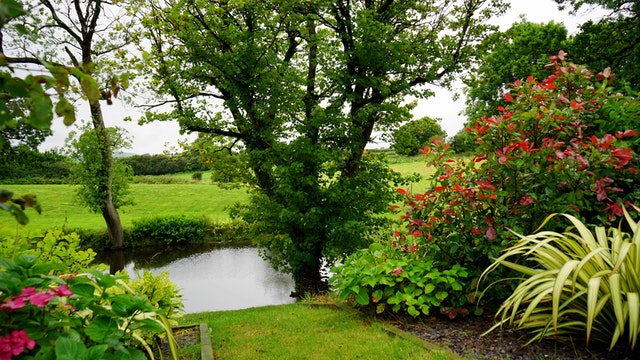
The open aspect of the unspoilt countryside, particularly the vista to the north
of the Menagerie, recalls the once great park and, now farm and woodland, the parkland
aspect has been retained by the judicious planting of copses and the view of the
distant lake and stream. The visitor’s first approach to the house and garden across
the mediaeval ridge-and-furrow field typical of the region, now grazed by rare-breed
cattle, is simply magical. The ruined folly was acquired, restored and adapted in
1975. By 1998, three years after the death of its former owner, the house was in
a state of accelerating dilapidation and the garden had stagnated.
Much work was needed; dirt tracks were replaced by metalled and gravel drives to
facilitate access, and extensive rebuilding and restoration of the Clipsham limestone
façade and the interior of the house was undertaken in 1999 by the current owners,
who also acquired land to the north of the house to permit a better perspective view
of both garden and house.